
COA Guides
GHK-Cu COA, HPLC & Purity: How to Evaluate Research Material
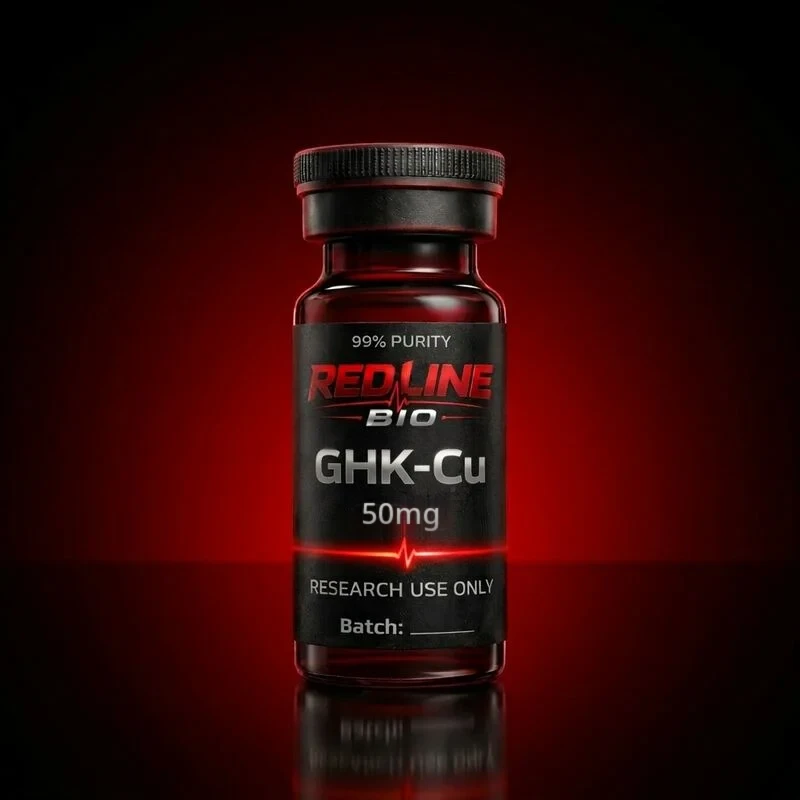
A GHK-Cu certificate of analysis (COA) records tests performed on an identified sample and the results reported for those tests. Its value depends on traceable sample identity, fit-for-purpose methods and a clear connection to the supplied lot. This guide addresses laboratory research procurement only, not human, medical or veterinary use.
What a GHK-Cu COA should contain
A useful review starts with the product name, chemical form, labeled quantity or strength, sample or batch identifier, laboratory name, report identifier and analysis date. The analytical section should distinguish test names, methods, acceptance criteria, units and actual results. Missing fields must remain missing evidence; a generic pass statement cannot substitute for a measurement.
- Material and sample identification, including the batch or lot code.
- Laboratory identity, report number, test date and revision information where applicable.
- Methods and results for identity, purity or impurities, and quantitative content when tested.
- Acceptance criteria and units, with supporting chromatograms or spectra where available.
- Explicit disclosures for unperformed tests and any relevant limitations.
GHK-Cu HPLC purity: what the number measures
High-performance liquid chromatography separates components under defined conditions. A detector measures their responses, and integrated peak areas may be used to calculate a chromatographic area percentage. That percentage is method-dependent. The column, mobile phase, detector settings and integration rules influence the result; the label HPLC purity alone does not specify all of these conditions [1,2].
Peak area is not absolute content
When a reported result is based on area normalization, it concerns the relative signals included in that chromatogram. It does not automatically equal the mass fraction of the entire powder. Components with different responses, undetected components and co-elution can limit interpretation. Area normalization reports relative detector responses for the integrated peaks under the stated method; it is not, by itself, a measure of whole-sample mass fraction. Peak-purity assessment is a separate question: a peak that appears single may contain coeluting components, and one separation cannot establish their absence [2]. Water, counterions and quantitative peptide content require appropriate separate evidence.
ICH Q2(R2) provides general analytical-validation principles covering uses such as identity, impurity measurements and assay [1]. It does not prescribe a universal GHK-Cu purity threshold. An article about validation principles must not imply that a particular Redline batch has undergone those procedures.
LC-MS identity verification
Liquid chromatography–mass spectrometry couples chromatographic separation to mass-related measurements. It can support identity when the observations are compared with appropriate expectations and reference evidence. The report should state what was identified and how the evidence supports that conclusion. A checked identity box with no method detail offers less reviewable evidence than a documented result.
Mass evidence has limits
Mass-related agreement alone is not an unconditional identity guarantee: different structures can share the same mass. Petersson and colleagues discuss peptide peak-purity assessment using two-dimensional LC-MS and the limits associated with same-mass isomers [3]. LC-MS identity, HPLC area purity and quantitative content should therefore be reviewed as complementary rather than interchangeable results.
Batch number matching comes first
The batch identifier on the report should match the supplied material's batch identifier or an explicit traceability record. A matching product name is not enough. Strength, packaging and the material form also matter. A report for a 100mg sample cannot automatically substantiate a 50mg product or a different lot. Cap color alone is not a substitute for a unique lot code.
Laboratory, test date and supporting records
The laboratory name and report number should be consistent across the COA and any verification record. An analysis date documents when testing occurred; it is not automatically a manufacturing date, expiry date or evidence of subsequent storage condition. Review should include the sample description, available chromatograms or spectra, and whether a report has been revised. An independently confirmed laboratory record is stronger traceability evidence than a filename or logo alone.
Documentation gaps and verification red flags
- A batch code is missing or differs from the supplied lot.
- A report is reused across strengths or batches without documented traceability.
- Purity, quantitative content and identity are described as the same measurement.
- Units, method details, acceptance criteria or supporting records are absent.
- An unperformed test is presented as a pass, or an unsupported safety or suitability conclusion is added.
- Formula and molecular-weight entries conflict without an explanation of chemical form.
Batch-specific results versus general testing practices
The Redline GHK-Cu product page and Lab Reports index are linked below. The index contains published batch documentation for a 100mg GHK-Cu sample: SteriGenix report RPT-2026-113288, batch SGX-RBL-2026-0814-U65, analyzed August 24, 2026. Its connection to current inventory has not been established; it must not be described as a current-stock COA. Accordingly, this article makes no exact lot-specific purity, net-content or conformity claim and does not identify that document as the current matching COA. No batch-specific result is inferred from general analytical references.
Before a current-batch COA link or exact figures are added, the supplied lot identifier must be matched to the laboratory report and supporting verification. A report that lists a test as not performed supplies no evidence for that test. Any broader statement such as GHK-Cu lab tested must retain the scope of the documented sample and the actual methods performed.
Concise procurement summary
- Establish exact product and batch traceability before applying COA results.
- Read HPLC area purity, LC-MS identity and quantitative content as separate measurements.
- Check laboratory, report number, date, units, methods and supporting documentation.
- Flag missing or unperformed tests instead of filling gaps with assumptions.
- Keep general method explanations separate from claims about a specific supplied lot.
Research references
- [1] ICH Q2(R2): Validation of Analytical Procedures (2023)
- [2] Stoll, Rutan and Venkatramani (2018). Peak Purity in Liquid Chromatography, Part 1: Basic Concepts, Commercial Software, and Limitations.
- [3] Petersson et al. (2023). A strategy for assessing peak purity of pharmaceutical peptides in reversed-phase chromatography methods using two-dimensional liquid chromatography coupled to mass spectrometry. Part I: Selection of Columns and Mobile Phases. DOI 10.1016/j.chroma.2023.463874