Research Materials
GHK-Cu Molecular Weight, Sequence & Copper Binding Explained
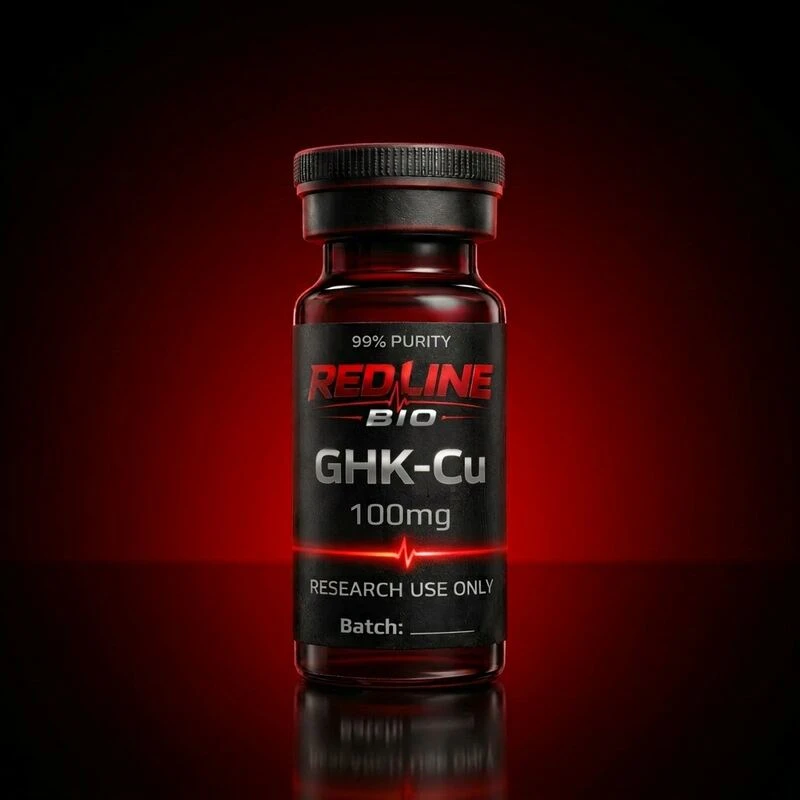
GHK-Cu denotes a copper complex of the tripeptide glycyl-L-histidyl-L-lysine. The sequence is Gly–His–Lys, abbreviated GHK. Chemical identity requires more than a product name: copper content, charge representation and material form must also be defined. This article addresses laboratory material identity only; it provides no human, medical or veterinary use instructions.
GHK-Cu molecular weight and formula
PubChem identifies copper tripeptide-1 as prezatide copper, CID 71587328. That record represents the positively charged species C14H23CuN6O4+ and lists a molecular weight of 402.92 g/mol [1]. The charge is part of the representation and should not be silently omitted. This value describes that chemical entity; it is not a measurement of the composition of a particular supplied powder.
Free GHK is a different chemical entity
Free glycyl-L-histidyl-L-lysine, PubChem CID 73587, is represented as C14H24N6O4 with a molecular weight of 340.38 g/mol [2]. The free peptide and its copper complex must not share an interchangeable molecular-weight entry. A value without a corresponding formula and defined chemical form is insufficient for material comparison.
Why chemical form matters
A chemical formula specifies elemental composition for a defined entity. Protonation, counterions, water of hydration and copper-to-peptide stoichiometry can change what an isolated material contains. A reference molecular weight therefore does not establish powder content, water content, copper loading or net peptide mass. The product specification currently lists C14H22CuN6O4 with 403.94 g/mol. The calculated average mass for that written formula is approximately 401.91 g/mol, while PubChem represents prezatide copper as C14H23CuN6O4+ at 402.92 g/mol. The product specification therefore requires supplier or laboratory reconciliation. Neither the reference record nor this calculation establishes the chemical form or composition of supplied material.
GHK-Cu sequence and copper tripeptide structure
The GHK peptide sequence contains glycine, histidine and lysine in that order [2]. Sequence identifies the peptide backbone; copper binding describes coordination between the peptide and a metal ion. Copper is not a fourth amino-acid residue. Likewise, knowing the sequence alone does not establish the supplied material's copper-to-peptide ratio or the proportions of copper-bound and unbound species.
The copper-binding peptide concept
Hureau and colleagues studied Cu(II)-GHK using X-ray crystallography and solution methods [3]. Their study describes coordination involving the terminal amino nitrogen, a deprotonated peptide nitrogen and histidine imidazole nitrogen. It also distinguishes a dimeric solid-state structure from monomeric solution behavior. A single simplified structural drawing should not be treated as a universal description under every experimental condition.
Conato and colleagues investigated copper complexes of GHK and synthetic analogues [4]. Such coordination studies provide evidence about chemical behavior under the reported conditions. They do not verify the composition of an unrelated commercial batch. Relevant research variables include solution conditions, metal-to-ligand ratio and the analytical approach used to characterize the complex.
Material identity is not the same as purity
Identity asks what the sample is; purity asks how much of a defined measured composition is attributable to the target under a specified method. HPLC separates components and reports detector responses. A high main-peak area alone does not prove the amino-acid sequence, copper stoichiometry or total material content. LC-MS adds mass-related evidence but requires interpretation against the defined entity and method. Identity, chromatographic purity and quantitative content are separate analytical questions [5].
Product and laboratory documentation
The GHK-Cu product record and Lab Reports index are linked below. Documentation should be matched to the exact material, strength and batch before a report is used to support a procurement decision. Current-stock batch linkage has not been established for this article, so no lot-specific purity, content or conformity claim is made. A general reference formula is not certification of a Redline lot.
Factual summary
- GHK is the Gly–His–Lys tripeptide sequence.
- PubChem's specified copper tripeptide-1 cation is C14H23CuN6O4+, 402.92 g/mol; free GHK is C14H24N6O4, 340.38 g/mol.
- Sequence, copper coordination, chromatographic purity and quantitative content answer different questions.
- Chemical form and exact batch documentation must be established before applying reference data to supplied material.
Relevant research questions
- Which chemical form and charge convention are specified in the material record?
- What evidence supports copper-to-peptide stoichiometry under the study conditions?
- Do identity and quantitative-content methods address the same material definition?
- Does the report batch identifier match the supplied lot, and are additional composition measurements available?
Research references
- [1] PubChem: Prezatide copper / copper tripeptide-1, CID 71587328 (formula and molecular weight)
- [2] PubChem: Glycyl-L-histidyl-L-lysine, CID 73587
- [3] Hureau et al. (2011). X-ray and solution structures of Cu(II) GHK and Cu(II) DAHK complexes: influence on their redox properties. DOI 10.1002/chem.201100751
- [4] Conato et al. (2001). Copper complexes of glycyl-histidyl-lysine and two of its synthetic analogues: chemical behaviour and biological activity. DOI 10.1016/S0304-4165(01)00127-1
- [5] ICH Q2(R2): Validation of Analytical Procedures (2023)